Thursday, July 15, 2010

Measured Drawings

During the winter of 2009, I had the honour to be a guest at the Palace Armouries in Malta. I took this opportunity to measure a shoulder armour. I felt that my shoulder armours were sorta good in that they "worked", but they looked like imposters. I needed to see and hold a real one for me to understand what details I was missing.
Mr. Cassar, the curator, found me a couple of fairly standard general issue shoulder armours, made in Milan around the time of the Great Siege of Malta. These shoulders were probably worn during that siege...they show all the signs of being made quick and while under pressure in a very competent shop.

Above is a close up of the upper cannon. Noteworthy points would be the stepped join at the inside of the arm, the flush rivets, the raw inside edges and the rolled edges everywhere which made the relatively light gauge bearable. The gauge of this particular armour was very light...by my estimate, in the region of 18 gauge, and maybe a bit less where the sander has taken off the hammer marks.
There seems to be a large number of people who feel that the light armour like this must have had a lot of heat treating to allow it to withstand combat. This material has been assayed, and the results pretty much throw such suppositions into a cocked hat. This is not high carbon steel, this material is low carbon enough to be considered iron, and it does not rely on heat treating to make it stiff, but rather on rolled edges and stepped fluting to do that job. Makes sense, a dented armour can still provide protection, heck, it even absorbed energy in the process of deforming, and if it is fairly malleable metal, it can be hammered back into place.
I have heard fans of the "alloy steel" camp state that the steel must have been alloyed with silicon in its manufacture, which would leave it stiff. Sorry dudes, nice idea but thanks for playing. You can tell in an assay whether the material under discussion is heat treated, or has ever been heat treated by the percentage of marstenite and cementite in the crystals. Fact is, these, these have been made as soft as possible by annealing, they were rolled, dished, and shaped, then issued to the troops. They seem to have very few stress fractures, and bullet holes deform as if the metal was made from 55 gallon oil drums.

I especially wanted to look closely at the buckles. Obviously leather has never lasted, but if you look closely, the centre bars of the buckles are attached to the armour by steel straps. Fairly straightforward one inch centre bar buckles.

Noteworthy point...the person doing the strap work used scraps of steel, and cast buckles. He did not bother to round the edges off, or otherwise worry about aesthetics. That being said, look at the beautiful articulation in the lames!


The word "spaulder" AND the word "spaudler" are NOT in the Oxford English Dictionary. If somebody can tell me the derivation, and provenance of this word, I will use it. Until then, I shall continue to just call it "shoulder armour". No, a dungeons and dragons concordance is not good enough!


ip-location map zoom

Sunday, July 4, 2010

Chivlary in Ottawa


This week Bruce Deachman published an Ottawa Citizen article on me. OttawaCitizen.com for July 4th. I seem to have made the front page, and all of page 12.

http://www.ottawacitizen.com/news/million/index.html


http://www.ottawacitizen.com/news/million/Knight/3216394/story.html

http://www.ottawacitizen.com/news/million/Soundslide+Knight/3216280/story.html?tab=VID


(The armour is a nice little piece I made for Lou up in Peterborough The photo is by Bruce Deachman, and is one of many remarkable pics in the Ottawa Citizen article. Please check it out!)

Friday, June 18, 2010


Way back when in history, the Basques chased whales all over the Atlantic Ocean, and long before Chris Columbus and even John Cabot made their famous trips to the new world, the Iberian whalers built settlements at Red Bay, Labrador. The reason for living in such a black fly and mosquito infested place? Well, there was lots of wood to put under cooking pots to render down whale blubber into whale oil, and lots of privacy. Especially privacy, since whale oil was a VERY valuable material. Also, it was on a migratory route for whales, the place where the gulf stream meets up with the Labrador current, creating a food supply second to none for shell fish in the world. And whales eat shell fish, so there were lots of whales. The heyday for whale hunting was during the 16th century, and thousands of whales were killed and rendered down into oil.
The basques hunted whales in a manner which remained unchanged for centuries...a shallop (rowboat for about 7 men) went out to the whale, and stabbed it with a harboon. The whale would take off, dragging the row boat in what was referred to much later as a "Nantucket sleigh ride". The whale could not sound (dive deep) because the water was comparatively shallow here. If he had been able to, he would have dragged the whalers to Davy Jones' Locker. As it was, the poor animal bled to death, and floated to the surface.
In the Parks Canada building, there is a room set aside that is like a museum. (Actually it resembles nothing so much as a self-congratulation room, and is about the same size as the Arthur Evans Room in the Ashmolean Museum in England, but doesnt contain nearly as much stuff) In there you find the paintings, several artifacts from the wreck, some models. The models pictured here are from the San Juan, a ship which came to grief in Red Bay.

The model above is of the sloop San Juan. The earliest Atlantic Ocean boat ever found.
The San Juan sank in fairly shallow water, and settled on its keel. Swimmers at the time yanked out the cross beams which formed its deck in order to salvage masts, decent sized wood, and of course, the expensive cargo. The sides of the ship folded outwards like the leaves of a book and settled on the bottom. Eventually, they were covered in silt, thereby preserving it to the present day.
Canada became a world leader in under water archeology, partly as a result of this wreck, among others. As I talked to the present day diver-archeologists, they told me that they much prefer under water archaeology to conventional land based research because "we are not standing on the artifacts when we are in the water".
This was not your nice Carribean or Great Barrier Reef diving experience either...this water was cold-cold-cold! Its the Labrador current after all, that is so cold that icebergs (being made from fresh water) don't melt in it! The divers gave up on using dry suits, and went to wet "hot water" suits, where hot water was pumped into their suits down the same umbilical which brought their air. The visibility was problematic since they were actually digging into that silt! Hoses were brought down to do the "digging", which had air blown into them in order to cause a flow of water, like a vacuum cleaner....the silt was brought up to the surface, and passed through screens so that nothing would get missed. So when this operation was going on, you saw your assigned aluminum taped square and that was about it.

More on the find here....
http://www.captaincooksociety.com/ccsu41146.htm


ip-location map zoom

Wednesday, June 9, 2010

Muskets

click on these images to enlarge.
Above is the before picture. Below is the "after" picture.
What a difference four hours on the buffing wheel makes!
(actually, they are two different Brown Bess flintlock actions, not really a true before and after! But trust me, the one below looked exactly like the one above!)

Both of these actions had broken main springs. You can see the busted main spring in behind in the above picture.


This is what they look like from the outside.


The above picture is a good one, you can really see what needs to be done!

Below are a couple of pictures I took when I was in "Parks Canada" for the "doors open". This is the archaeology room, and these are how the muskets look after being on the bottom of the St. Lawrence River for a couple of hundred years.

I particularly like the x-ray in the back. Now, these are not Brown Bess Muskets, but rather, they are an American made musket. Or should I say, a British musket made in the Colonies in the Americas! It was lost during King Philip's war. (1675) (Don't be surprised, nobody ever heard of that war either! Too bad, it nearly put paid to the whole British colony thing in the New World!)
Note the remarkable upturn at the butt. Other than that, the above flint lock could drop into that big open space on the side with no modification at all!


ip-location map zoom

Sunday, June 6, 2010

Burgundian Armour, Leeds


click on these images to enlarge.

This is a remarkably interesting armour because it has so many "late period" features in it, and yet it is quite early, circa 1525. It would have been on the cutting edge of armour making at the time, and likely nobody else would have had an armour as nice. Anywhere!
Which come to think of it is as good a reason as any!


This armour is clearly a jousting armour. It has been beautifully dished out in that nice "globe" style which was so popular at the time. The placquart is really nothing more than a waist defining belt, and the wrap around leather belt might be regularly chewed up by the armour since I note a fair amount of wear on the surface of the bottom half of the placqart. Probably by the faulds.


above is a close up of the incised St. Andrews cross, shewing the damage. There is more damage in the upper corners of the breastplate. I suspect from the damage (the above looks like a crossbow bolt or possbly a musket ball hole which has been carefully laid back into place.) Why would he do that? Well, honourable battle scars come to mind.


The pattern in the bottom of the insised cross is hard to make out. To my eye, it doesn't really look like a pattern, so much as swirly bits perhaps designed to hold enamel or neillo in place. This is the earliest example of a breastplate which was level and straight across the top, which means of course that you will need a very very good gorget. If anybody wants the full size (1.5 meg) picture, just email me and ask for Leeds2009 288, and I will send it to you.


For those that say that centre bar buckles are not period, I say "in your face!".


The gorget is a thing of absolute beauty. A four lame gimbaled gorget. How advanced is that!

And the gloves. Nice late period mitten gloves with semi-belled cuffs.

ip-location map zoom

Thursday, June 3, 2010

German Armour


This is a German armour on display in Nurenburg. The general form of this armour is designed to make the owner look out of proportion. Observe the size of the upper arms...they are bigger than the legs! The huge rondels, the odd stacked gorget, and the really open face helm conform to civilian fashions of the day. Lets get over that shall we, and see what we can see. Click on the images to enlarge them.
The first thing you see is a lance rest. So this is a jousting armour right? Well, maybe. Or maybe that was just the style of the time. But it was most definitely a horseman's armour. The lack of armour on the inside of the legs tells us that. The profusion of decoration merely means the owner wanted to show people that he had lots of money. My personal feeling is that if somebody went to all the trouble to decorate the armour he would probably not want to get it scratched up in the joust. But hey, maybe he knows an armourer.
The arms and gauntlets are general issue...would have been worn by anybody from Malta to Inverness. The elbows are those big late period pieces with the huge wrap around wings. The gauntlets are flared, a little bell shaped to allow the wrist to "break" from side to side. In common with almost all the gauntlets of the age, you can not curl your wrist inwards when you wear these gauntlets, though of course, you can put your hand on the ground and heave yourself back up...they bend backwards just fine. The scales for fingers is very unusual for a German armour...normally the Germans liked the knobby knuckle look. And the Spadlers up top are neat and plain, and the fact that they are symmetrical left to right puts the last nail into the idea that this would have been used for jousting!


This armour is worth taking a little closer look at. From a distance, you would think it was Italian...it has those nice smooth lines and not a bit of that fluting which we normally associate with German armour. I should develop a big essay about the movement of armour styles from Italy to Germany to England to France, however I think its been done. This being only a mere blog, we will just take a quick look at these pics I imported from the Nuremburg Museum web site. Suffice it to say that in one year, everything changed, and made it a real trick to be able to spot the country of origin from a distance.

I originally studied this picture because it has such a great cod piece and fauld arrangement. Its very complicated, the faulds and the tassets are designed to match neatly together, the only way you can tell one from the other is by the buckles in fact! It really IS a three lame fauld, the big difference of course is that the lames are sort of "vee" shaped. I would have thought that the point of the vee would have made a weak spot, but the rolled edge at the top of the cod arch would stiffen things up remarkably. I see the armour maker had a really difficult time making that arch lie neatly...glad I am not the only one!

Those little spikes at the top of the tassets towards the inside...I'm open to suggestions...I just don't know why they are there. If a reader does know...well, the comments section is below!

I don't usually talk a lot about the decoration of armours since even then, the armour let this armour out of his artisan hands and into the hands of an artist. However the faux roping along the top edges of all the plates is a bit unusual, and makes a nice fancy decoration.
The buckles which hold the tassets onto the fauld are also worth a second look. They are not centre bar buckles, but rather, more standard "dee" ring buckles, and the keepers are spaced well away from the buckle itself. The "keepers" (those little metal things that keep the free ends of the leather under control) are attached to the metal tasset. A great idea, especially since they match the buckle itself, as well as that of the surprisingly light duty main armour waist belt. And of course, I don't think I have ever seen tassets which have straps which attach to the leg, but since they are made up of six lames each, there had better be a way to keep them tucked in nice and tight.
The cod piece itself. Hmmm. This is a masterpiece of the metal worker's art! A very devil to make. It probably takes twice as long to make that codpiece as it would to make the faulds and tassets together. I could not do it without a fair amount of welding!

A closeup of the breast plate. The armourer had his placqart sliding under the breastplate. An arrangement which is new to me...one does not normally see that! It likely helps the owner to look less plump. Clearly this was a time when skinny was the thing to be. The decoration also provides a bit of tromp l'oil, making the fellow look thinner than he actually was. A great trick borrowed from the clothing of the time.
The breastplate narrows as much as he dares in front, and side pieces ride in slots to allow the fellow to be able to get his arms forward, say, to grasp his reins.
The fastening systems are also not the usual jousting types...observe the turning keys for the spadlers up top, the cords holding the rondels in place, (they must bang around in a MOST annoying fashion when he rides!) are just two items which would get sheared away pretty quickly in a real battle.


ip-location map zoom

Thursday, May 20, 2010

10 G helms


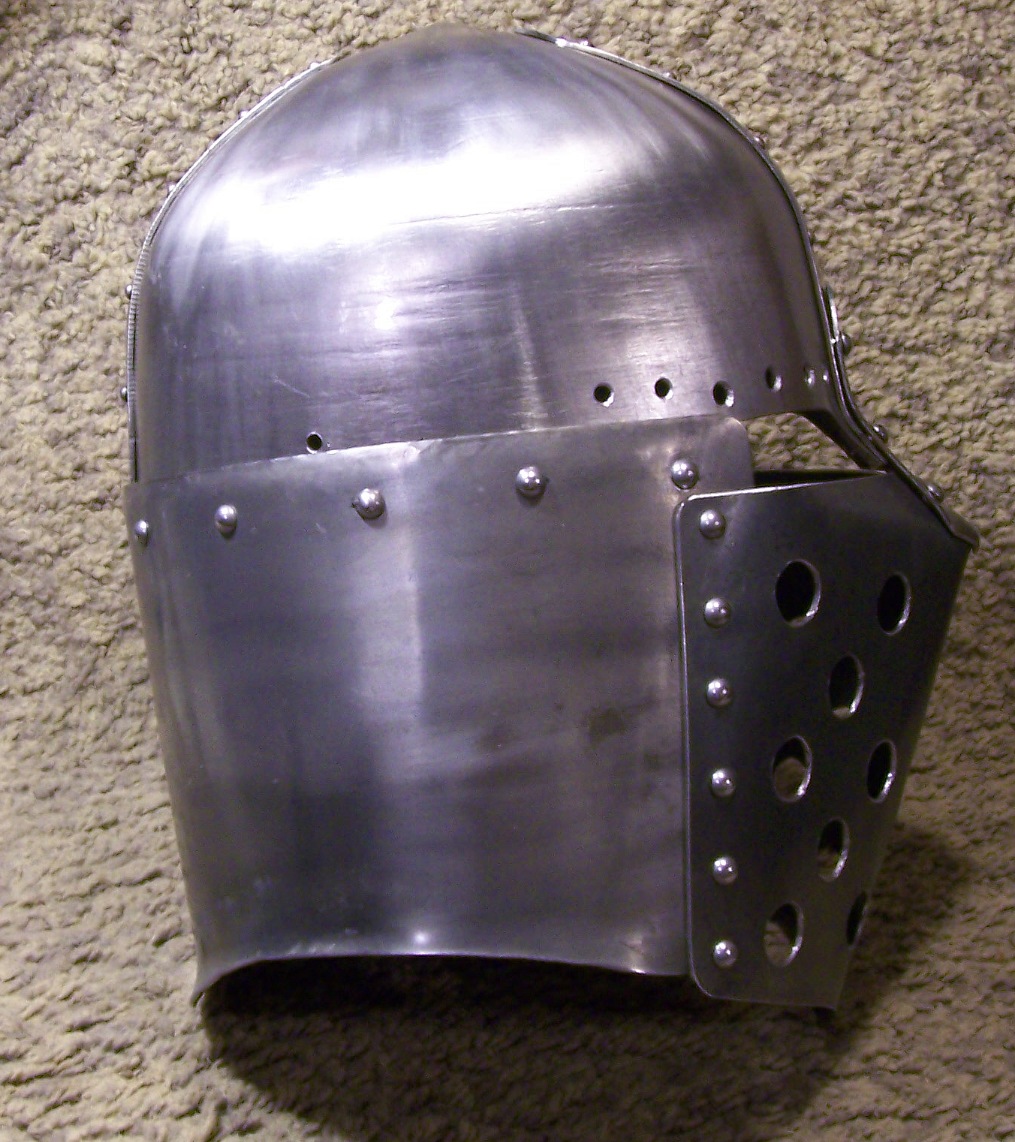
This is a fairly standard 10 g helm. They are "entry level" helms, It is made from a ten gauge spun top, riveted to a fourteen gauge body. They are expected to take a lot of impact and should last for years. There is plenty of room for padding, and they are inexpensive as I can make them and still not compromise on the quality.
Lots of breathing holes allow the client to get air, and odd holes in the brow above the eye slots provide a distant early warning of overhead shots. The double holes on the sides are for a chin strap. My camera died just as I took this picture, and so I don't have any from the front.

The second style is a bit of a mash up, and it is below.

This one is a little prettier. The problem with the spun bowls is that though they are cheap, they are "round". Heads, in general, are not round but oval. Narrow wedges have been cut front and back so that when we push the sides in, it will narrow it a little. Not a lot, but enough to allow the helm to look really good. Should still provide lots of padding. This was actually MY helm, one that I had worn in countless photo shoots. I modified from a top lid with a lobster tail to a SCA legal helm. There was enough padding in there for me, so it should be okay for the client. When you look closely, you can see some of the holes from its previous incarnation as a lobster tail hat. They don't affect the useability, and they will give the new owner something to talk about!
(There is one oval hole in the side, you can see it in the picture if you click to embiggen it. Your guess is as good as mine...grin!)

The holes in the brow just provide a little more warning for overhead sword shots. Again the two smaller holes on the sides are there to mount a chin strap. On inexpensive helms like this, there will be a lot of sanding marks. But all the edges have been properly finished to prevent damage to rattan swords, and the high rounded rivets don't catch the rattan, but they give the helms a steam punky boiler plate look.

The back curtain is recycled from a fourteen gauge galvanized steel renaissance festival sign. Seems I ran out of fourteen gauge at JUST the wrong time, and I really wanted to get these finished. Way back when the Renaissance Festival closed, I bought all the signs, just in case I needed them some day. And the day came.
(nothing wrong with them, and it somehow seems proper that a piece of the Ren Faire goes on to fight again!)

This helm did not need the big horizontal "barrel" band, and so I just mounted it directly to the skull. The skull around the edge has spun so thick that it is just under a quarter inch, so you don't really need the horizontal band. By skipping the band, I saved about a half hour of time, and saved the customer some money.

specs....

10 G helms....
11 gauge spun tops, with tool marks sanded off clean. fourteen gauge curtain and face plate. Rivets are 3/16 rivets, spaced 2 inches apart or less. Comes with simple chin strap. eye slots are between 7/8ths and one inch in size. (you cannot get a one inch dowel into them) These helms meet and exceed all SCA, AEMMA, and JFC regulations.


ip-location map zoom

Wednesday, May 19, 2010

A knight rebuilt


This is the University of Dundee's CSI style reconstruction of a knight who would have died in a tournament around the time of the battle of Stirling Bridge. (1297) The scar on his forehead was a healed battle axe wound, (must have bled like hell!) and there is a second one on his left brow. The fact that he survived it shows the value of a helmet! In addition to his damaged noggin, he had an arrowhead lodged in his chest. That arrow might have slowed him down some, but the sword blow would have finished him off.
This is what the fellow would have looked like before the sudden violent blow which eventually killed him...a sword blow which sheared through his nose and jaw.
Considering where he died...Stirling Castle....there is a certain amount of question about his identity, however at five foot seven inches, and very solidly built, the young man (in his mid 20's) was used to handling weapons. His bones were very solid, and the insertion points of tendons indicate that he was very solidly built. No doubt his physique would have resembled that of a modern rugby player. He also had the characteristic bone spurs on his hip bones of extensive and regular horse-back riding.

Best guess of his identity...Robert Morley, English knygt, died in tournament at Stirling Castle 1388. Though apparently the Time Team people have a different theory, and are putting an entire episode together to prove it. Well, we will see now won't we!


The University of Bradford's Dr Jo Buckberry examines a female skeleton which was found alongside that of the knight underneath the castle chapel.

One of the best articles about this work may be found here.

It is by examining the relics of the past that we learn so much of how they lived, and in this case, died. It is interesting of course to see what the bones can tell us about the individuals involved, however as Dr. Jo Buckbury (who did the excavation) states, "This group is highly unusual, because of where and when the people were buried, suggesting that they might have been socially important and have died during extreme events such as sieges. "

The "Time Team" people will have a whole episode on this fellow on Thursday. "Stirling Man". In it they will attempt to show why this fellow is NOT Bob Morley, and who he might be instead. Can't wait!


ip-location map zoom

Friday, May 14, 2010

Summer Academy of the Arts


My name in print again!

Algonquin College in Ottawa Ontario, Canada, is trying a new thing....summer academy of the arts. These are week long special interest courses. I have been asked to teach two courses, one on "how to make armour" and another on "How to make chain mail". This accounts for two of my weeks this summer at any rate! I imagine the usual caveats apply...if there are not enough sign ups, they won't run the course. But considering how many people have expressed an interest in these things, it seems to be a positive sort of thing.

http://xweb.algonquincollege.com/ads.aspx?id=877

Armour on week four (July 26-30), and chain mail on week six (August 9-13). I think I'll be taking a class myself, the "lost wax casting" course on week three.


ip-location map zoom

Wednesday, May 12, 2010

The Ordinances of Richard II


Will McLean on his "Commonplace Blog" has sussed out the rules that governed his knights. He had them made up, and read to his troops as part of his Scottish campaign. Francis Grose (1801) had translated it into the vernacular, and hats off to Will McLean for finding it!

It funny, there are only XXVI simple and concise rules. Things like
"XX. ITEM,
that every one shall well and duly perform his watch in the army, and with the number of men at arms and archers as is assigned him, and that he shall remain the full limited term, unless by the order or permission of him before whom the watch is made, on pain of having his head cut off."

Compare to the modern military's full shelf full of Queen's Regulations and Orders, none of which mention the head cutty offy part. And I note, that like the modern QRO's, Richards "KRO's" have almost every thing to do with how to get on in day to day life, and nearly nothing about how to conduct a campaign. It is also interesting to note the harsh penalties compared to modern times...clearly the people that King Richard were using to consolidate his hold on the kingdom needed to be kept on a very tight leash. Or maybe like his dad, he was just being a Dick....
(sorry, could not resist it!)

http://willscommonplacebook.blogspot.com/2010/01/ordinances-of-richard-ii.html


The illustration at the top is a very rare glimpse of the inside of a brigantine armour. This one dates to rather later than Richard II, but from all I have read and studied, there would have been very few differences. Most armour during the time would have been chain mail of course, but this was the "transition" period. Big pieces of armour, because they are welded up from small marble sized bits, scraps and one pound trade bars would have broken too easily.

ip-location map zoom

Monday, May 10, 2010

Old barrel helms


These un-dated barrel helms were in the Tower of London Museum in Leeds. We are looking at the age of chain here, though for the purposes of jousting, these heavy helms would have been ideal.

Here is a close-up of the helm. The damage is, well, understandable. It is iron after all. however, details worth noting are the amazing narrow eye slots. The rivets instead of forge welds. The nasal which comes out a bit in front. Ahhhh so THAT's how they made room for the nose!


The above helm is remarkable in that the eye slot seems to be nothing but a saw cut in the edge of the helm. Makes me wonder if it is possible to see out of it! However, that big piece of metal with the smiley face holes is a door, with a hinge on the left side, and a fastener catch on the right side, so it may have been open most of the time, and only slammed shut at the last second.

The houndskull here is much the same design...clearly made for jousting. Two halves of heavy steel form the body, and a most menacing pointed nose with not enough breathing holes for comfort in them. This face plate slides up when not protecting the fellow's face. Note the integral gorget. That's different!

A later period close helm way in back. Does it belong here I wonder?

click on the above picture to see all of them together.

The helm on the far right is also a real "pot helm", made for function, not looks. There is something very "medieval" about that helm. The high frankenstein forehead clearly provides a ton of protection from rocks being tossed off the battlements, and the face plate is open until needed, at which time, it is nice and cozy and safe against arrows and such.

I wish these were dated, but I suspect the only real way to date them would be to examine medieval manuscripts with similar equipment being shewn. However after having read on another fighting blog that medieval armour was uniformly light duty, I just had to point out that a lot of the real fighting was done by guys in good heavy armour.

Late breaking news....

Hello,
>
> I have a comment about your blog post from 10 May, 'Old barrel helms'. I'm
> afraid all those pieces are 19th century fakes from the workshop of the
> infamous Samuel Pratt. They were believed to be original when first sold or
> "discovered", but have since been proven fake. That whole little room on
> the Tournament Gallery mezzanine was dedicated to 19th century medievalism
> and fakes, which is why the close helmet was with the helms. I don't know
> where they will be when the new Tournament gallery opens later this summer.
> Hopefully they'll be better labeled, at least.
>
> Regards,
> Nick D
>

So I checked with my copy of Laking's book, and what a surprise, the very same pictures I have up here are shown to be fakes. Ha ha! I consider myself to be "punked"!!!! I urge anybody who has an interest in armour (and their fakes) to check out Mr. Lakings books. Here is a link to the relevant page.


ip-location map zoom