Saturday, October 30, 2010

Reginald's suit

Here is Reginald's suit. It has very clean lines, and the pecs are sculpted in. Well made from sixteen gauge cold rolled steel.
You can see the thousands of hammer marks which remain even after the irons have rolled them out. The marks by this point don't exist as "marks" but rather variations in surface texture. If I was to paint it at this point you would not be able to see a single hammer mark.

As you can see, Reginald is a very fit and solid individual...he has a barrel chest and a reasonably slim waist. The chest is easily pulled out or pushed in as required if Reginald desires to wear padding underneath the armour or not.

The back is pretty. See how I shoved it up a bit...there is plenty of room for mobility.

Nothing fancy, just simple curves. But it IS made from 16 gauge steel.
From here, things are going to get a little more interesting since Reginald is actually not getting me to make medieval armour at all, but rather an interesting personal design.

More as I make it....


ip-location map zoom

Algonquin Grads, 2010 Basic course


ip-location map zoom

Wednesday, October 27, 2010

Iron

Pure iron is barely harder and stronger than copper. Impurities are to iron, what paint is to an artist's canvas.

Red Ochre is Iron

The problem with iron at this level of purity is that it is too soft and too ductile for most commercial uses.

This means that the iron products that we know and recognize are relatively and deliberately impure.

Iron also has three allotropes or crystal forms, delta iron (body centered cubic) gamma (face centered cubic) and alpha, body centered cubic. I was originally taught* that delta and alpha iron were the same allotrope, a distinction that now appears to be a charming sign of old age… and the addition of impurities (alloying elements) have different solubilities based on these forms.

It is the addition of carbon and other elemental impurities which alter these allotropic forms that gives commercial iron and steel products their diverse properties.

When we look on the material certs that accompany our steel products , the first element that is reported is carbon. Carbon is ubiquitous, and has the dominant effect on the behavior of the iron based product to which it is part, even in the presence of large amounts of alloying elements.

What is implied by the certs is that after adding up all of the elements reported, the balance of the material is "iron."

In 2009 world Iron and steel production was estimated to be 1,219.7 million metric tonnes.

Physics trivia: Iron is the heaviest atom that can be made by the fusion of stars. Iron is is the 'ash' of stellar nuclear fusion. Iron is abundant- the fifth most abundant element on earth, and sixth most abundant in the universe. Our blood is red because of iron, and since iron is an essential part of our bodies, we can truly claim that we are "Stardust."


The preceeding is written by Miles Free on the Engineer's Blog. More on this topic here...

http://cr4.globalspec.com/blogentry/14418/Iron-The-Implied-Element?frmtrk=CR4digest


ip-location map zoom

Wednesday, October 20, 2010

Fight Books


(click on the above images to enlarge.)

When you get two or three sword trainers together, you get disputes and opinions. The task of a historian is to cut through the opinions, and determine the underlying truth in order to form your own (no doubt disputable) opinion. In the case of sword fighters, the opinions usually come down to "which school or style is better". Mr. George Silver, a sword fighter who bitterly opposed the "new fangled Italian style" wrote two books. The first was an off-putting non-stop diatribe against the Italians, the second is much harder to find but is more useful in that he discusses the "Englyshe Style of Broad Swerd" with great thoroughness and depth, a worthy sucessor the Marxbuder German style popularized by Talhoffer and Meyer. DeGrassi discusses the introduction of rapiers and the desire to not lug a shield around all over the place. Savolio is often considered the genius behind the creation of a foil and Achille Morozzo is considered the first codifier of cuts, guards, wards and parries.

The book by Egerton Castle referred to above is a wonderful compilation of these opposing viewpoints! Mr. Castle created a history of the art of sword fighting and has strenuously declined to determine "which is better". He and I agree that a fighter who is poorly trained in a superior style will lose against a fighter who is properly trained in an inferior style. Rather like the question "what sword is best in a fight", the answer of course is "the one you brought with you, not the one you left at home in the closet", the question of which style or school is "better" can be answered simply by observing which school trains their students daily, which school is more intuitive, which school is more capable of training folks who really have no knack for sports, and which school teaches techniques which can be transfered to other weapons easily. And perhaps, in this modern age, which school can stay interesting enough so that even the most jaded belt hunters will come back to it again and again.

Take a week of evenings, and read Castle's dissertation. I will guarantee that you will be the better for it.

http://www.archive.org/stream/schoolsandmaste00castgoog#page/n3/mode/2up


ip-location map zoom

Monday, October 18, 2010

Scale Tunica


The light from the flash can pick up the plastic scales, but in normal day to day light, you can't tell the difference.
There is a plastic row of scales forming a kidney belt, and hard scales covering his spine and menubrium. The rest is nice soft leather scales.


Click on these to see them full size. These pictures were painted by an artist in the fourth century on the walls of a small church on the slopes of Mount Olympus. (that would be central-west in the long skinny island that is the birthplace of Aphrodite...among others. Including my personal goddess...Nemesis.) (Google it Dude!)

I figure that the artist was actually painting from life. The Tunic was short for a horseman, when I made my interpretation for Lou, I made the tunic longer.


ip-location map zoom

Tuesday, September 21, 2010

Jason got a sword.

So Jason got a sword.  Paid a buck for it on EBay, and it still cost him twenty five bucks shipping and duty.  It had a broken tang and some rust.  Just the blade...no handle or scabbard.  It was folded steel though, and the decoration was hand chiseled. 


Monday, September 20, 2010

Interesting emails

Dear Mr. F.,
I'm looking to get 2  pieces made, approx. 12-14"x6". One end convexed (1")
the other end concaved (1").
I can give more exact dimensions and a detailed drawing of what I am looking
for if you can provide me with a rough price range first.

Darron Pxxxxxxxxx
 
 Bill says about that.....
Hmmmmm...two pieces of what do you suppose? Steel? Aluminum?  Cheese?
Well, below is another one. 
 
xxxxxxxxxxxxxxxxxxxxxxxxxxxxxxxxxxxxxxxxxxxxxxxxxxxxxxxxxxxxxxxxxxxxxxx
 
High there,

I'm looking to order a few peaces from you and would just like to get a over
all price quote in US$(if possible with shipping, I live in California). The
items i was looking to get made are as follows: the 10-G Helm with the
German spangen upgrade, the 12-c-2 Two piece suit 16g battle armor (would
prefer the buckle to the sliding rivet) and a plywood 32" by 23" curved
shield blank.

Look forward to hearing back from you, will get the funds in order and get
the needed measurements so we can get the ball rolling.

Thanks,
Mike
 
Bill says about that.....
Well, Mike, what would you like me to tell you that is not on my web pages?  As it is, Mike dropped off the radar and never did get back to me, and when I emailed him, he told me had purchased from a local guy. 
 
xxxxxxxxxxxxxxxxxxxxxxxxxxxxxxxxxxxxxxxxxxxxxxxxxxxxxxxxxxxxxxxxxxxxxxxxx
 
 Brxxxxxxx asked...

The scales that come with rivets and everything else, do you  assemble it and it costs
2.00 per scale, or is it somthing you need  to do yourself? I live in Ontario as well,
but where is your store  located in Ontario?
 
Bill says about that...
Not such an unreasonable question, no doubt the statement on my web site is a little vague.... the website says "for those that want to build their own scale coat". 
  Don't know why he wanted to visit, but if he did, instructions are all over my web site.  Not sure why he wanted the scales, but his email consisted of words which implied that he was an armour maker himself.  Oh well....scales take an inordinate amount of time to make.  Maybe I can get them stamped out cheap someday.  When that day comes, no doubt the production scales will be too pointy, too rounded, too heavy, or not heavy enough with the holes all in the wrong places.   (Gawd I hate scales!)

xxxxxxxxxxxxxxxxxxxxxxxxxxxxxxxxxxxxxxxxxxxxxxxxxxxxxxxxxxxxxxxxxx

I contact via the shop phone, but I wanted to send you an email as  well. I love your
flat top helm. Especially the one with the grill  face. I was wanting to know if you
could do a flat top helm with a  grill that looks like the one in this video? 
http://www.youtube.com/watch?v=fM39fsrzl-o I love the way the helm  is more narrow in
the front, and the vertical grill looks so mean.  Basically, I am looking to recreate
the helm seen in the video, but  flatten the top and keep a crusader look on the sides.
I would love  to exchange some more ideas as I am looking to purchase from one  armory
exclusively, and then kind of endorse them at events. Contact  me and let me know wheat
you think.

Thank You,
Matthew

PS Can someone make a purchase from you with paypal?

Bill says about that......
I love letters like this....the guy is so keen and he wants so much to get into fighting.  And he has a good idea of what he wants....he sends me to a long and rambling video which features a helm with a grill face, which he likes.  Yet, I did find it a little disturbing the fact that the only thing he took away from that lecture is the cool grill face on a helm. Nothing about period re-enactment, safety, protection, visibility, any of the things an armourer has to consider.  The topper is that he wants a crusader barrel helm modified in a way no crusader ever thought to modify his helm.  I passed on this job BECAUSE he would tell people where he got it.  I don't want my name attached to such a blatantly non-period item. I can live with non-period features for safety reasons, but this is not why he wants this modification...if he wants crusader, then go with the closed face helm. Too bad actually, he seems like such a nice fellow...but his marshals should have advised him better.

 
  And no, I don't take paypal, I am a legitimate established business with my own merchant accounts. 

xxxxxxxxxxxxxxxxxxxxxxxxxxxxxxxxxxxxxxxxxxxxxxxxxxxxxxxxxxxxxxxxxxxxxxxxxxxx


Mr. F.
Thank you for recently speaking with me about my desire to have a  custom suit of armor
fabricated.  As promised, I have put some more  thought into what I actually want in my
suit of armor.

To that end, I have attached JPG files which contain drawing  illustrations of my
proposed suit of armor.
          
As discussed, I would like to base my custom suit of armor on your  original 3-Piece
suit of armor with a few modifications.  The most  important modification is that I
would like the majority of the suit  to be fabricated from 1040, NUMBER 3 GAUGE Medium
Plain Carbon Steel  Sheet which is 1/4 inch thick (0.2391 inches) instead of the usual 
NUMBER 16 GAUGE steel that you normally use.  Thus, I would like my  suit to function as
a real-world suit of armor.  Thus, my proposed  3-piece suit of armor would be designed
based on your original  3-piece suit of armor but would be fabricated from a thicker
gauge  of steel.  Thus, any additional cost beyond the approximately $1,500  for the
3-piece suit illustrated on your website would be for the  time and labor to work with
the thicker gauge of steel which may  involve heat treating the NUMBER 3 GAUGE of Steel
Sheet in order to  temporarily soften the still before hammering work on your anvil.

My questions to you are:

1.  Are you able to fabricate a NUMBER 3 GAUGE suit of armor?

2.  Do you have any concerns or objections about fabricating a  NUMBER 3 GAUGE suit of
armor?

3.  What would be the additional cost for making a NUMBER 3 GAUGE  suit of armor?

 
Bill says about that.....
Hmmmm....no question that this fine gentleman knows that gauge sizes go heavier as the integers go down...he realized that his armour would end up being quarter of an inch thick.  This email came after I had talked him out of stainless steel!  Even so, I passed on this job because the end product would still be in excess of 250 pounds.  Nice fellow though....he came back later with an alternate proposal which he would actually be able to walk in, something in sixteen gauge.  The pictures were quite interesting...his sketches implied that this fellow actually might be Tony Stark.  Hmmm.  Never made an armour for a super hero before!  So this looks like it could be interesting, and I think I'll take that job. 
 
xxxxxxxxxxxxxxxxxxxxxxxxxxxxxxxxxxxxxxxxxxxxxxxxxxxxxxxxxxxxxxxxxxxxxxxxxxx
And the list goes on.....


Sunday, September 12, 2010

The great spaulder, spaudler, spauldeler debate.

Letter from Mike.....

Hi Bill,

Always interested in new tidbits of history, I was provided some additional info on the Spaulder/Pauldron topic. Thought you might be interested as well.


Your friend is correct that "spaulder" is something of an anachronism, but then again, so too is "shield." At any rate, "pauldron" is also likely incorrect, as it is based on a single sixteenth-century work, amid more prevalent variations.

The proper term for what you're looking for in Modern English is "spaudeler," which is what you'll want to look up in OED.

The earliest attestation in English is probably "spawdeler," c. 1450-1509, in Richard Coer de Lion, line 5285

"Spauld" (spaud) as shoulder is possibly attested in English as early as 1305, and certainly by 1313.

"Spanbelere" is a copyist's error for "spaudeler," so don't be confused by it.

"Pauldrons," or more correctly "Pouldrons," is first attested in English in 1439, as "palerns;" 1454: "pollerons;" 1465: "polrondys."

There are various cognates for "spaudeler", including Middle Low German "spoldener" and Middle High German "spaldenier."

(And Bill's research is as follows) ..............
In the OED, a spaulder is a person who spualds, that is to say, spalls flint off nodules and it isn't an anachronism at all.  The word "spauldeler"  is listed as "obscure, rare, but at least it is English, albeit Old Engish.  Espauliere is of course French. 

The "New English Dictionary" became the OED.  Since the Oxford English Dictionary is so long and tedious, they have always had a "concise" oxford dictionary, which is of course, the one volume reference work beside most Canadian desks. ( What is sometimes a little annoying is when a word is in the "concise" but isn't in the ten volume NED.  The word "spaudler" is a case in point and another charming word "spadassin", that is to say, a swordsman.)  Fortunately, we have the interwebs, and most of these old books have been scanned into the


http://ia341333.us.archive.org/0/items/ANewEnglishDictionaryOnHistoricalPrinciples.10VolumesWithSupplement/09.p1.NEDHP.SiSqSt.Oxford.Murray.1919..pdf
page 530


The general usage in the Tower of London seems to be "Spaudler"  (pronounced spawd-ler)  .  The NED word, "spauldeler" is pronounced much the same, "spaw-del-er".  I have to admit that I have yet to find a reliable reference to "spaulder" as applied to shoulder armour, though the "Random House" dictionary reference makes me think that there is an American usage.  Like the word "armor" for "armour".  But though you can blame a whole lot of language disruption on Mr. Webster's attempt to streamline the English language, the fact remains, he was silent on the subject. 

Coutere is a perfectly good word which has been bastardized into "elbow cop", and it is also properly called "cowter".  The reference in Richard Coer De Lion is on line 5285, which also contains the word cowderbras.    I like the word "cowderbras".  Which of course is another word for "arm armour".
      A vambrace was originally just the forearm guard, but of course, it quickly became the term for the whole arm, the "cowterbras".  I'll stick to using "vambrace, coutere, and rerebrace" for now.

references...below.

  http://ia341332.us.archive.org/0/items/ANewEnglishDictionaryOnHistoricalPrinciples.10VolumesWithSupplement/02.NEDHP.C.Oxford.Murray.1888...pdf
pages 1098 and 1116

Tuesday, September 7, 2010

The Lou Bin


Lou S. asked me to make him a Byzantine armour.  It had to look fourth century. And it had to meet or exceed SCA regulations.  It must also work like a charm.  Right oh then.


.


 Semi-articulated forearm guards


 Forearm guards are clamshell opening...they pivot open on the rivets under the elbow cop.  Big concession from the original is the wing. 


 The gorget is totally not Byzantine....even though I tried my best by incorporating a Roman Lion decoration.  OTOH, it will protect his neck. Interesting variations are the deep cutouts on the sides to allow Lou to swing his arm up overhead.


 I swept the top of the "chin" portion forward a lot to allow for greater comfort.  Nothing is as uncomfortable as a goget, and hopefully, this will be better than most.


 The back is beaten out to match his back since this gorget is designed to fit closely to his skin. 

 Four eyelets on each side.  Two for the arms. Two for adjustment.

 Click on this picture to see it full size.  this is the inspiration.  Below, you can see the upper arms based on the above picture.  Again, lots of eyelets, hopefully at least two of them will be suitable to lace to the elbow cops. 


Below are the shin pads.  If I had gone sixteen gauge for all of it, they would have weighed him down  something awful!  So I replaced part of the lower leg with leather.  Again with the Roman lions.  Would have been a site easier to make articulated knees...these only "look" easy!  Oh, and I made them from that pretty hot rolled steel.  If you look at them closely, you can see that I modeled the shin bone and the flares for the calf muscle.  


The third from the bottom picture is the inspiration for Lou's armour.  He called me up way back in February, and told me he wanted a Byzantine armour.  For SCA fighting.  "But Lou", I said, "Byzantine armour is not suitable for SCA combat...it is all open faces and scale and stuff which is good for bladed weapons, but not so good for SCA beatin' sticks!  Even the materials...they used light gauge brass and bronze, the SCA requires heavy sixteen gauge metal.  They didn't have gorgets and kidney belts and stuff. 
 Like a fool, I agreed that there might well be ways to make an SCA armour which will pass for Byzantine armour at first blush.  Almost every thing had to be invented from the ground up...this is not a normal armour!  The fact that there is no articulation on the joints is a serious problem.  There are no knee cops at all, just someting resembling shin pads.    The deep dishes take an inordinate amount of time.  I am not sure if they are SCA legal yet...they might need some flanges still, see if I can protect the sides of the knees.  
  These pieces are almost all the third incarnation, sometimes the fourth, since it takes a couple of tries to get them right. For every piece you see up here, there are two in the scrap pile!   The result by now is not too bad, and not so bad price wise.   Because Lou allowed me to take my time, they got done right. 

Now to see about how to get all those scales made into something which will meet SCA regulations.  Then it'll be done.


ip-location map zoom

Tuesday, August 24, 2010

Summer of battle

What a birthday party!  I decided to fight all day...in fact, I fought fifty four fights...one for every year I have been on earth.  There are pictures of me on line I hear...there is one of me fighting Mark, where he disarmed me, and I brought my gauntleted fist into the side of his head.  Apparently I look like all kinds of mean and nasty!  Ah well.  Nice to have friends!  And friends that let you win.  (I'll try to find the pictures and post some of them here sometime this week.)

It was more like a marathon than otherwise.  But I did it, with only one cracked finger.  Its the baby finger anyway, I can still swing a hammer, but hitting the "enter" key on the computer is special level of distraction.


In fact, it has been a heck of month!


 The month opened with the Upper Canada Village Medieval Festival.  Thats me to the right, with Brenda failing to hide in behind.  Check out the coat of arms in front!


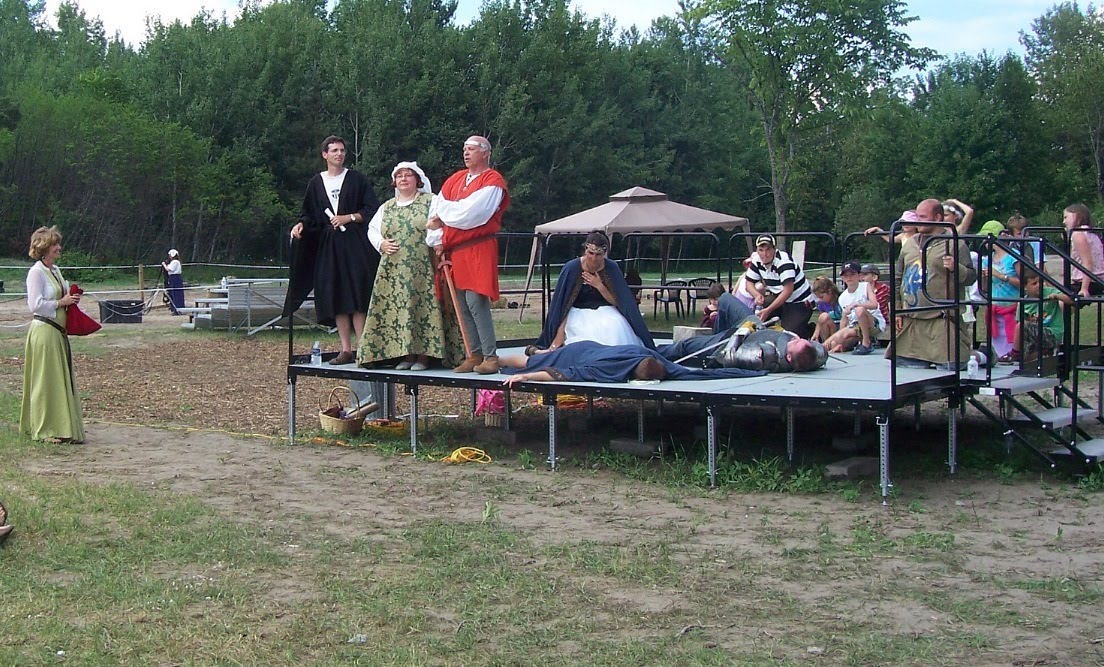
Then we had the Osgood Medieval Festival to contend with.  Thats Jeff, lying dead on the stage.


A.J. looking really good in her heat blue'd armour.  She is right to be proud of it...and yes, she can see through that chain mail just fine!


This was the graduating class from Algonquin College.  They had me teach a week long seminar on "Basics of building armour".  As you can see from the armours all built by the students, (admitedly not completely finished, but thats only a matter of time) I was very ambitious. I didn't do ANY chain mail at all!
 And the scheduled chain mail course was cancelled due to lack of interest.  Pity.....

We DID get a course graduated this week from Plante Baths Ottawa Recreation Centre.  What a nice collection of soldiers.

And of course we graduated a class from Algonquin College.  Again, a fine collection of soldiers..
This week is all about preparing and cleaning armour to take to the Science Fiction Expo in Toronto.  And assembling a scale tunic.   And cleaning spinnings to ready them for helmet making. 
          Most definitely looking forward to September when AJ and Mark will be back working in the shop.


Wednesday, August 18, 2010

3 days work

Doesn't look like three days work does it?

ip-location map zoom

Wednesday, August 4, 2010

7 causes of quench cracking in steel

This is not good.
This is from the cr4 forum site.
Photo is from British Blades.


http://cr4.globalspec.com/blogentry/13519/7-Causes-of-Quench-Cracking-in-Steel

However, upon reading, I find that CR4 pulled the post, and picture from Miles Free's blog site...
http://pmpaspeakingofprecision.com/

Please bookmark Miles' site....and maybe join the CR4 forums...


ip-location map zoom

Monday, July 26, 2010

Jeff De Boer armour for pets


http://www.beautifullife.info/art-works/armour-for-cats-and-mice-created-by-jeff-de-boer/


ip-location map zoom

Wednesday, July 21, 2010

Summer Academy of the Arts


Algonquin College has asked me to do a week of armour making as part of the "summer academy of the arts". This is a daunting task. There is a LOT to do to prepare for this.
As of this morning, I have 6 students signed up for it.

Its course MMA0230 and it occurs on week four.

(cut and paste from the web site)
Bill Fedun has been instructing armoured sword handling at Algonquin College from 2002 until the present, and involved with sword based martial arts since 1979.

From the foundation of 20 years of military experience in designing workshops and courses of various types, Bill has moved on to pursue his true passion for making Medieval body armour.

Bill has travelled the world to make measured drawings of real armour in museums, and combines this acquired knowledge with more than twenty-two years of experience to re-create the original patterns, and modify those patterns to fit modern 21st century clients.

This summer, Bill will teach:
· MMA0230 Techniques for making Medieval Armour
· MMA0231 Making Chainmaille Armour and Jewellery


Supplies for Techniques for Making Medieval Armour:
Instructor will supply specialty tools, but students are encouraged to bring their own pliers, ball pein hammer, claw hammer, black sharpie, notebook and tape measure. Instructor will supply necessary materials at cost. Bring $75.00 on the first day to cover materials.


How exciting! This is, as far as I know, the only course of its kind taught in North America.

Lots of work to do to get ready! The lesson plan is all done, and the anvils are loaded into the car.

The picture? Well, that was back when I was young and pretty...grin!

ip-location map zoom

Thursday, July 15, 2010

Measured Drawings

During the winter of 2009, I had the honour to be a guest at the Palace Armouries in Malta. I took this opportunity to measure a shoulder armour. I felt that my shoulder armours were sorta good in that they "worked", but they looked like imposters. I needed to see and hold a real one for me to understand what details I was missing.
Mr. Cassar, the curator, found me a couple of fairly standard general issue shoulder armours, made in Milan around the time of the Great Siege of Malta. These shoulders were probably worn during that siege...they show all the signs of being made quick and while under pressure in a very competent shop.

Above is a close up of the upper cannon. Noteworthy points would be the stepped join at the inside of the arm, the flush rivets, the raw inside edges and the rolled edges everywhere which made the relatively light gauge bearable. The gauge of this particular armour was very light...by my estimate, in the region of 18 gauge, and maybe a bit less where the sander has taken off the hammer marks.
There seems to be a large number of people who feel that the light armour like this must have had a lot of heat treating to allow it to withstand combat. This material has been assayed, and the results pretty much throw such suppositions into a cocked hat. This is not high carbon steel, this material is low carbon enough to be considered iron, and it does not rely on heat treating to make it stiff, but rather on rolled edges and stepped fluting to do that job. Makes sense, a dented armour can still provide protection, heck, it even absorbed energy in the process of deforming, and if it is fairly malleable metal, it can be hammered back into place.
I have heard fans of the "alloy steel" camp state that the steel must have been alloyed with silicon in its manufacture, which would leave it stiff. Sorry dudes, nice idea but thanks for playing. You can tell in an assay whether the material under discussion is heat treated, or has ever been heat treated by the percentage of marstenite and cementite in the crystals. Fact is, these, these have been made as soft as possible by annealing, they were rolled, dished, and shaped, then issued to the troops. They seem to have very few stress fractures, and bullet holes deform as if the metal was made from 55 gallon oil drums.

I especially wanted to look closely at the buckles. Obviously leather has never lasted, but if you look closely, the centre bars of the buckles are attached to the armour by steel straps. Fairly straightforward one inch centre bar buckles.

Noteworthy point...the person doing the strap work used scraps of steel, and cast buckles. He did not bother to round the edges off, or otherwise worry about aesthetics. That being said, look at the beautiful articulation in the lames!


The word "spaulder" AND the word "spaudler" are NOT in the Oxford English Dictionary. If somebody can tell me the derivation, and provenance of this word, I will use it. Until then, I shall continue to just call it "shoulder armour". No, a dungeons and dragons concordance is not good enough!


ip-location map zoom

Sunday, July 4, 2010

Chivlary in Ottawa


This week Bruce Deachman published an Ottawa Citizen article on me. OttawaCitizen.com for July 4th. I seem to have made the front page, and all of page 12.

http://www.ottawacitizen.com/news/million/index.html


http://www.ottawacitizen.com/news/million/Knight/3216394/story.html

http://www.ottawacitizen.com/news/million/Soundslide+Knight/3216280/story.html?tab=VID


(The armour is a nice little piece I made for Lou up in Peterborough The photo is by Bruce Deachman, and is one of many remarkable pics in the Ottawa Citizen article. Please check it out!)